
Posted by Admin
February 17, 2026
How To Monetize AI-Generated Music Across Streaming Platforms
Last Updated: Feb 2026
Artificial intelligence music is a song that awakens in a different body. It is sound, feels sound, but the paperwork may be empty. That is why individuals post songs, wait until they receive AI royalties, and hit pause. This tutorial demonstrates how to safely monetize AI-generated music and being able to post on Spotify without flags.
Streaming money is not magic. It is plumbing. The valves that allow flows of royalties are rights, metadata, and clean credits. Make every upload like a release; even one detail can make streams make zero payouts.
Why AI Music Monetization Seems Complicated
The production is accelerated by the use of AI, yet the revenues still rely on the platform regulations, rights, and human creativity if you want to monetize AI-generated music properly.
The Myth Of Passive Income Overnight
Some months ago, uploading more was an idea. In 2026, there will be spam on the platforms. Spotify has implemented content farm and bad actor prevention and is more transparent about the usage of AI. Most creators continue to pursue an imaginary per-stream rate when Spotify actually pays by streamshare, rather than a per-play rate. Spotify also requires Tracks to have 1,000 streams within the past 12 months to earn recording royalties under the 2024 model.
AI-Assisted Vs AI-Generated Music
Music using AI assistance has human manipulation: arranging passages, recomposing melodies, recording vocals, introducing instruments, or editing stems. Complete AI music production is more like prompt in, song out, and is seldom considered to be creative control. This is important about AI licensing and copyright & PRO registration.
Recommended Read: AI Songwriting
Who Are the Real Owners of AI-Generated Music?
The person who created the final piece of creative work owns it, not the person who clicks the generation button.
The Human Authorship Requirement Explained
It is believed that prompts are co-authors, leading to controversies. According to the U.S. Copyright Office, human authorship is needed; prompts do not necessarily generate copyright. Human selection, arrangement, and creative control can render a work to be protectable, case by case.
Basic principle: Use AI output as crude clay, and form it in the manner that is obvious to you before you monetize AI-generated music.
Copyright Ownership Vs Commercial License
- The commercial license questions: Does this output allow commercial use?
- The copyright ownership question: Do I have a protectable claim in the final work?
A commercial use can be a paid plan, but it does not provide copyright in the absence of human authorship. Store documentation; receipts can be used on demand by distributors.
What PROs Will and Won’t Register
- The rules of PRO are changing, and a 2026 revision is helpful. ASCAP, BMI, and SOCAN currently admit registrations of compositions by humans mixed with AI. Works that are fully AI-made are ineligible. This does not mean that automation is a green light. It is a hybrid street of creators to include real writing, organization, and creative choices.
Recommended Read: Technical Challenges and Ethical Issues in AI Music Generation
The AI Music Monetization Map
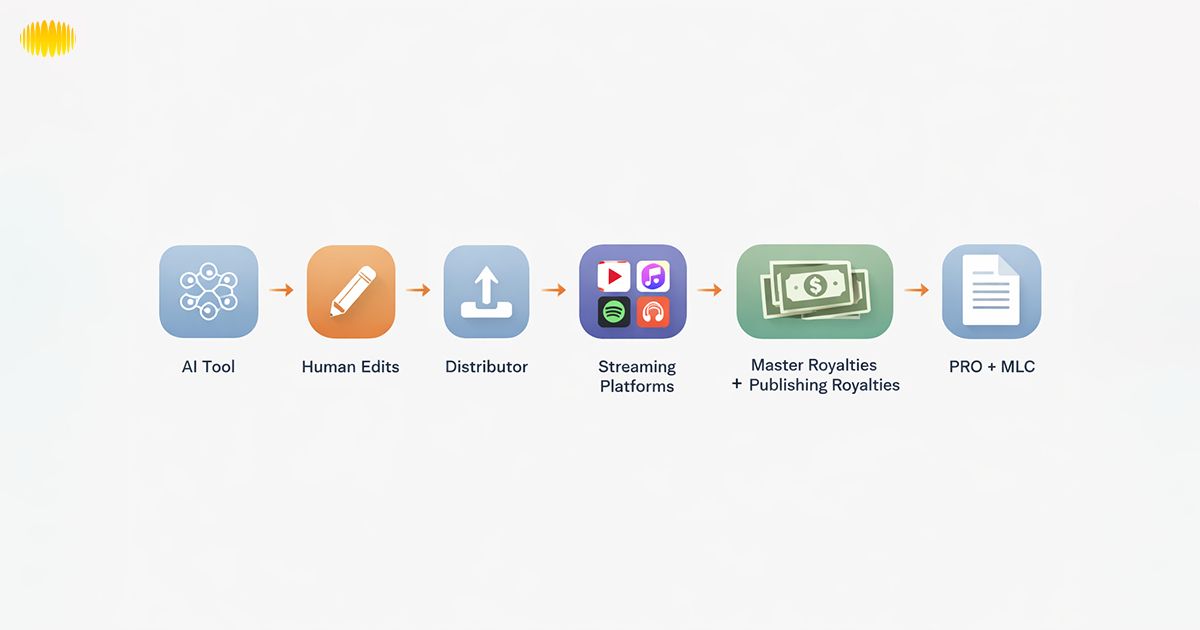
The following is the monetization map within a short period:
Royalties (Master Rights) Recording
These are by the sound recording. Streaming services make payments to rights holders through your distributor. Payments are based on your plans and divisions. Spotify describes Streamshare and the distribution of revenue between recording and publishing.
The Royalties (Composition Side) Publishing
This includes topline, songwriting credits, harmony, and lyrics. A PRO collects performance royalties that are used publicly. Streams or downloads are the source of mechanical royalties. The MLC deals with digital mechanics in the U.S. Missing the publishing set-up leaves cash behind.
Distribution Platforms Accepting AI Music
You can have your AI music on streaming services. But distributors demand clear evidence that your song is not breaking the rules.
What Distributors Seek In AI Tracks
AI music distribution services and DSPs typically worry about four things:
- Rights clarity
- No voice resemblance or impersonation abuse
- Metadata requirements for AI music
- No spam behavior
Distributor Comparison Table
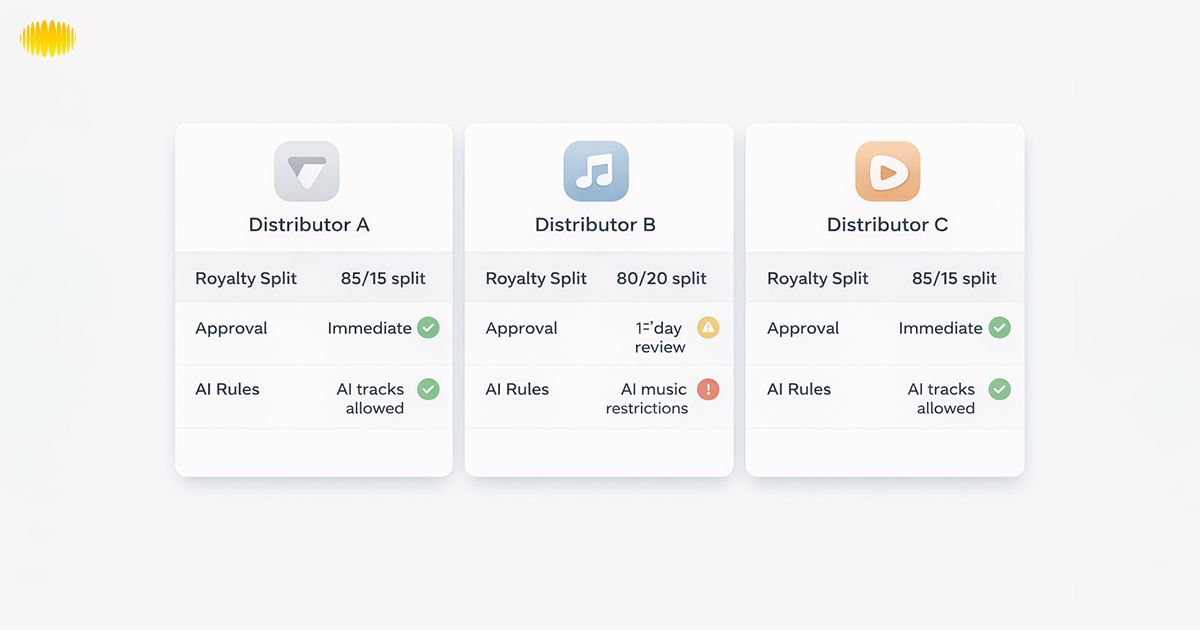
Policies evolve; verify the support pages. The table displays up-to-date creators' guidance.
| Distributor | Ai Policy Snapshot | Cost Model | Good Fit For | Main Risks |
|---|---|---|---|---|
| Distrokid | No Ownership Or Rules Of Dsp, It Is Fine To Accept AI Music. | Subscription | Rapid Releases, Quick Process | Metadata Errors Can Increase Rapidly |
| Unitedmasters | None; The Content Should Comply With Partner Rules | Tiered Plans | Basic Analytics Distribution | Platform-Specific Policy Guidelines |
| Cd Baby (Downtown) | Nurture Trust, Fraud Prevention, And Catalog Quality | Pay Per Release | Slower, Curated Releases | Flags Can Initiate Requests For Proof |
| Landr | Dsp Rules Can Alter; May Ask For Proof If Flagged | Subscription Tiers | Slower, Curated Releases | Accepted Content Can Still Be Rejected |
| Tunecore (Believe) | Does Not Share Entirely AI-Produced Content | Tiered Plans | Hybrid Composers, Organized Collections | Complete Ai Tracks Can Be Subject To More Scrutiny |
← Swipe horizontally to view full table →
Streaming Platform Enforcement Trends
Three patterns define the distribution of AI music on streaming platforms in 2026:
- Spam filters got smarter; Spotify emphasizes anti-fraud
- The policies on impersonation were made stricter; voice clones and false identities are both fast-takedown
- Eligibility systems were altered; tiny uploads aimed at pennies were discouraged at Spotify
How To Monetize AI-Generated Music (Step-By-Step)
The first step to making AI music is not the end. You must have a system and a plan to make money safely.
Step 1: Acquisition of Commercial Rights
- Look at the plan you used on your AI app (Sonygram, Suno, Udio, Stable Audio, or any text-to-music application)
- Streaming and monetized video is permitted to be confirmed as commercial usage
- Copy documents: invoices, plan name, terms screenshot, and project id where applicable
- Make a folder to store everything in every release, named the Rights Folder
Step 2: Add Human Creativity
This is where most of the people hurry. Protecting should be its section.
- Export stems and restructure the setup in your DAW
- Not only sounds but change chords
- Write/ rewrite lyrics and hooks
- Vocals, even simple record vocals
- Include instruments or new top lines
- Split stem parts, reassemble
Keep version files and dates. You will not fall back on memory; otherwise, questioned. Copyright still is biased towards human authorship. Creative control matters.
Step 3: Prepare Metadata Appropriately
Metadata is not admin work. It is your payment routing.
Key areas that can be used to prevent conflicts:
- Track title
- Name of the artist (do not use lookalikes)
- Credit for writers and songwriters
- Writer splits
- ISRC
- Release date
- Explicit flag
- AI is available on demand through your distributor
Bad splits retard the publication of money. Wrong credits create claims. Spam checks are caused by duplicate uploads.
Step 4: Upload Through A Distributor
You can upload AI music to Spotify nowadays with fewer surprises.
- Normal pacing; One heavy stroke falls on many light strokes
- Do not use a false branding or type beat name
- No voice imitations; no copycat singers
- Clean art and metadata
Spotify protects the identity of artists and combats misuse by deception.
Step 5: Register With A PRO
You register performance AI music royalties on the composition side under the name of PRO.
Basic steps:
- Be part of a PRO that suits your region and ambitions
- Register the composition in case of confirmation of writer credits and splits
- Retain confirmation screenshots
- If you have any publisher or publishing administration, pitch everything the same way
In the case of hybrid works, the aligned ASCAP, BMI, and SOCAN policies are useful in explaining what could be registered in 2026.
Recommended Read: How to Use AI To Write Better Song Lyrics
Metadata And Rights Management Checklist
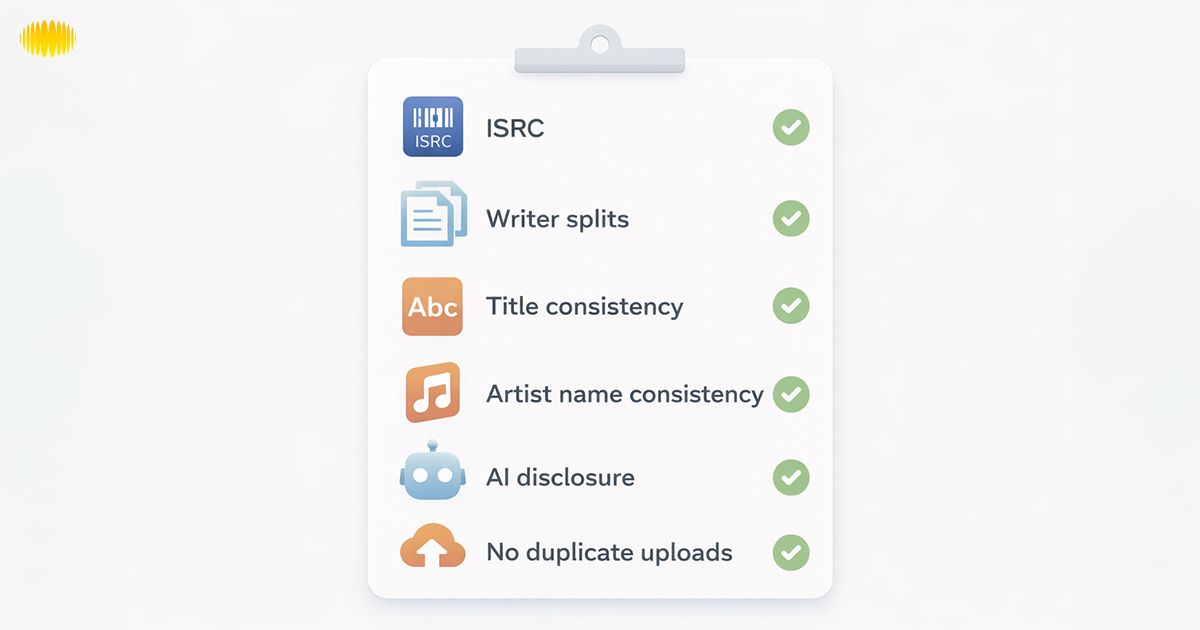
Do not forget to confirm your details before clicking release. Metadata errors bring money to you in the future.
Essential Metadata Fields
This list is a last scan before release:
- Title matches the name of the audio file
- The artist's name is unique and consistent
- Writers listed correctly
- Splits total 100%
- ISRC assigned per track
- The distributor schedule is the same as the release date
- No duplicate audio or other titles
- Creditors named fairly
AI Disclosure Best Practices
Provide information regarding the use of AI when requested. Keep it simple. YouTube can also label modified or artificial material in case of disclosure.
Common Metadata Mistakes That Kill Monetization
- Misplaced wrongs can cost publishing cash
- Confusion of writer-producer credits
- Posting the same song twice or thrice
- Metadata using a well-known name to gain visibility
- Placing yourself on the list as a sole writer when you did not write any major sections
How Streaming Royalties Actually Flow
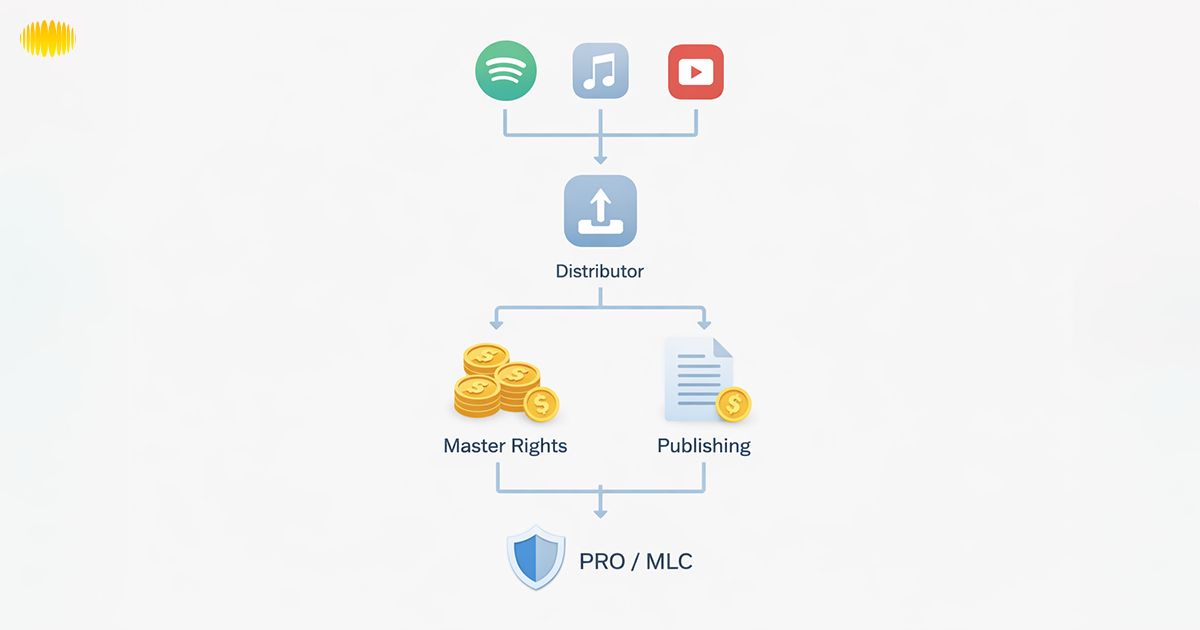
Knowing the money flow secures income.
Recording Vs Publishing Breakdown
The most common mistake that beginners make is streaming royalties vs publishing royalties.
- Recording AI music royalties: master side, through distributor
- Publishing AI music royalties: composition side, collected via PROs and mechanical systems
Spotify defines streamshare and the split of revenue between recording and publishing on a general basis.
Normal Streaming Reality Payout
Streaming is most profitable with true fans, rather than random plays. Spotify is not set at a specific per-stream rate; there is a different payout based on the location, subscription, and platform revenue. There is also the 1,000 stream eligibility, which influences the tracks to receive recorded royalties.
Platform-Specific Monetization Tips
The platforms perform differently. The way your music makes money can be influenced by little changes in strategy.
Spotify
Build indications that appear human to prevent spam.
- Release less, market more
- Not only plays, but also saves and follows
- Naturally keep track lengths; no ultra-short “farm” formats
- Establish a single identity as an artist
Spotify shares information about more powerful AI safeguards and anti-abuse.
Apple Music And Other DSPs
The listeners seem to be library builders. Strategy changes:
- Many singles perform poorly when compared to EPs or co-escapes
- Sound must be good, more than witty prompting
- Metadata is to be kept clean; rules are rigid in editing
YouTube And YouTube Music
Content ID monetization is good, but the risk increases when the rights become ambiguous. Two safer options:
- AdSense via your own channel
- Music distribution through your distributor
Do not use repetitive mass-produced content. Disclose tools should be used when synthetic media may be deceiving. Work with the best distributors for AI music to reduce claim conflicts and protect revenue flow across platforms.
TikTok
Indie creators' first discovery, second revenue. Content Credentials label AI content automatically in 2026.
Practical moves:
- Keep the artist name consistent
- Avoid imitating real voices
- Post short videos, breakdowns, or snippets of processes
- Relocate fans to email lists and streaming profiles
Recommended Read: Best DAW for a Beginner
Real-World Earning Examples And Financial Reality
Remain realistic about streaming income. Smart planning is achieved through clear expectations.
Example Streaming Scenarios
Revenue is based on location, tier mix, and splits. Precise figures vary, but examples can help.
- Scenario A: 100,000 total streams across platformsEarns not a salary, but a humble income. The demand is reflected by the value: playlist adds, followers, and repeat listeners.
- Scenario B: 100,000 streams plus clean publishing setupWith PRO (performance rights organization) registration and splits, publishing provides a second source of revenue. Most creators overlook this and believe that they have been paid.
The payouts at Spotify operate based on a monthly explanation of the streamshare.
Why Streaming Isn’t Enough
Streaming builds attention. There are several channels of stable income.
The Myth of Monetization Debunked
- Myth: Uploading huge volumes is the fastest pathReality: Spam filters on platforms; Spotify cuts incentives on small tracks
- Myth: Prompts equal ownershipFacts: The authorship and creative control are in the hands of humans
- Myth: YouTube will monetize anythingFact: Mass production is unauthentic and dangerous
AI Music Legal Considerations And Compliance Risks
AI music opens up new possibilities, yet opens up grey areas in the law. When you do not pay attention to compliance, you may lose your income and catalog.
Copyright Ambiguity
The legal aspects of AI music are developing in different regions. This is the safest road to go: introduce purposeful human imagination and retain evidence. The U.S. Copyright Office has asserted that issues of copyrightability are often solvable under the current law, which is based on human authorship.
AI Licensing Risks
Tool terms change. Platform rules change. Distributors update their risk systems.
Keep a proof pack per release:
- Tool plan proof
- Project files
- Stems
- DAW session or edit history
- Metadata sheet
- Final masters
Voice Imitation And Impersonation Risk
One of the quickest ways to get a takedown is voice cloning an established artist or persona. Spotify has mentioned the need to safeguard artist identity and fight against deceptive misuse related to AI.
Risk Mitigation Checklist
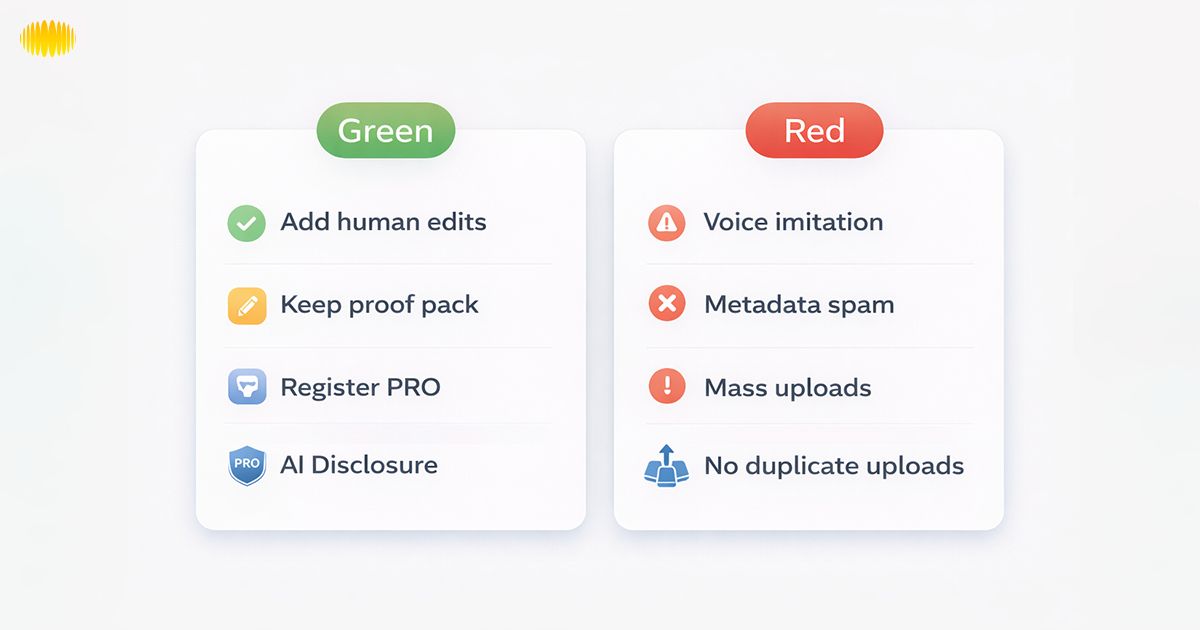
- Utilize credible devices and retain evidence
- Add human creativity, which alters structure or expression
- Personalization or voice abuse is to be avoided
- Release at a realistic pace
- Keep metadata accurate
- Maintain uniformity in keeping between the distributor and PRO
Monetization Beyond Streaming
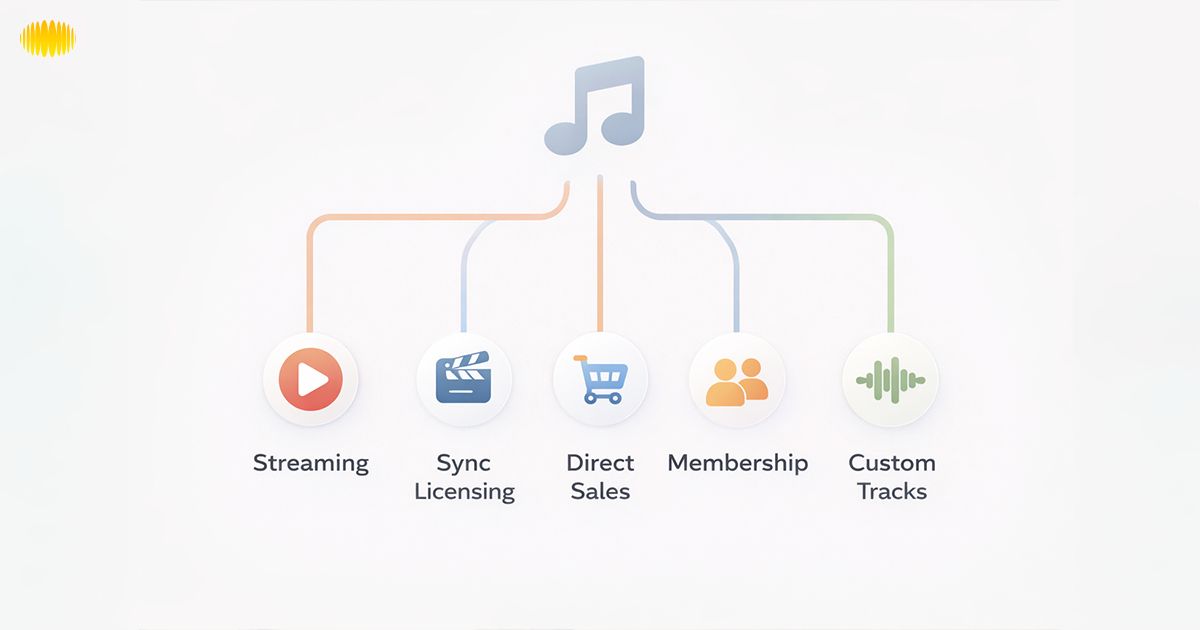
Going beyond streams allows for more stable sources of revenue.
Sync Licensing
Under clean rights, Sync can be beaten by streaming revenue within a short time.
Basics that help:
- Keep stems ready
- Keep instrumental versions ready
- Keep the proof pack ready
- Avoid samples and voice imitation
Direct Sales And Superfan Models
Direct sales can do more heavy lifting if you would like to sell AI-generated songs outside of streaming.
Good options:
- Sample packs and drum kits constructed of your own
- Stem packs and project files
- Early supporters lose membership
- Creator and small brand custom tracks
Emerging AI Licensing Revenue Models
There is a silent movement towards provenance. Platforms are shifting to authenticity signals. This movement indicates that future licensing will be based on the evidence of origin, permission, and authorship rather than legal discussions.
Recommended Read: Sad Song Generator
A Safer Workflow For AI Music Monetization Using Sonygram
Sonygram is not a shortcut system.
Treat it as your idea engine. Write quickly, and enter into a human stage. Export stems. Rebuild in your DAW. Shift sections. Remove predictable loops. Add tension, then release. A real bridge helps; a real hook aids greatly.
Then create a “Release Proof Pack” per track:
- Tool plan proof
- Sonygram project exports
- Stems
- DAW session or edits
- Lyric sheet, in case you composed lyrics
- Metadata sheet and splits
- Final master
Do a quick “Impersonation Audit” before upload. Check artist name, cover art, vocal tone, and promo copy. Nothing must promise anything like a true artist. Pace issues as of a man artist. One strong song, then another. This cadence is so natural and holds the listeners near.
Frequently Asked Questions (FAQ’s)
1. Can I Monetize AI-Generated Music?
Nothing must promise anything like a true artist. Pace issues as of a man artist. One strong song, then another. This cadence is so natural and holds the listeners near.
2. Do I Need To Disclose AI Use When Uploading?
Share on demand by a retailer or media. In realistic situations, YouTube has a disclosure policy on altered or synthetic content.
3. Which Distributors Allow AI Music?
Most of them tolerate AI-assisted music provided that you own the rights and adhere to platform regulations. The guidance by DistroKid and UnitedMasters discusses AI uploads.
4. How Much Does Spotify Pay Per Stream?
Spotify does not have a fixed rate, but applies streamshare. Incomes differ across nations, grades, and your splits.
5. Can YouTube Reject AI-Generated Music?
Yes. Content may fail to be monetized when it appears to be mass-produced or inauthentic, and disclosure policies exist regarding some synthetic media.
6. Is AI Voice Imitation Legal To Monetize?
High risk. Voice likeness and impersonation may attract takedown and lawsuits. AI places anti-impersonation on a platform.
Final Thoughts: Monetizing AI Music The Smart Way
A streaming site does not constitute a suggestion box. It is a rules-based, filter-based, and memory-based marketplace. Use AI as an aid, not a masquerade. Add human creativity, which actually transforms the track. Keep your proof pack. Use clean metadata. Register composition side. Build multiple income lanes. This is what you do to monetize AI-generated music in 2026 without panicking, takedowns, and the questionable upload and pray process.