Posted by Admin
February 18, 2026
Prompt Engineering for AI Music: Genre-Specific Tips & Templates
AI music tools now generate millions of tracks every month, yet most outputs fail to reach professional quality. Why? Because vague prompts create structurally unstable music. AI music tools now generate millions of tracks every month, yet a large share of outputs still fall short of professional quality because vague prompts create structurally unstable music.
Vague instructions, such as make a chill beat or generate EDM, produce generic results. AI systems require structured musical direction. Without a defined tempo, key, arrangement, and production style, outputs remain inconsistent.
This guide explains how to write genre-specific AI music prompts that produce reliable, professional-quality results. You will learn how models interpret instructions, how tempo and key stabilize composition, and how to build reusable frameworks for monetization.
Recommended Read: How To Monetize AI-Generated Music Across Streaming Platforms
Understanding AI Music Models and Prompt Engineering
AI music models interpret prompts probabilistically. They map descriptive language to learn musical patterns. The first descriptors in your prompt carry disproportionate weight because models prioritise early tokens during generation.
- If you start with: Upbeat electronic festival anthem. The model locks into the electronic festival structure before processing instrumentation details.
- If you start with: A soft piano melody. The rhythmic and harmonic direction shifts immediately.
Why BPM Stabilizes Rhythm
Specifying tempo anchors the rhythmic grid. Without BPM, the model estimates speed based on genre probability. That leads to an unstable groove or unintended pacing.
Why Missing Vocal Details Creates Errors
If you don’t define:
- Male or female vocal
- Clean or raspy tone
- Verse-chorus structure
- Hook emphasis
The model may:
- Add vocals unexpectedly
- Generate abstract vocal textures
- Misplace chorus sections
Ideal Descriptor Range
Use 4–7 core elements. Too few = generic. Too many = diluted signal.
Universal Prompt Formula
Use this structure:
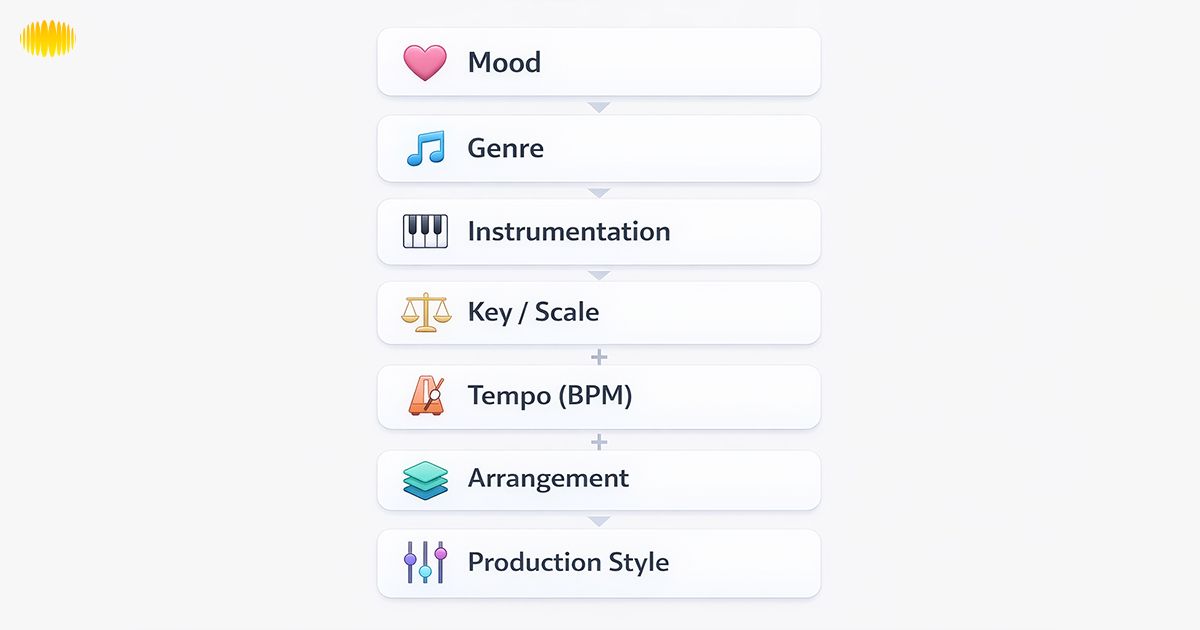
Mood + Genre + Instrumentation + Key/Scale + Tempo/BPM + Arrangement + Production Style
Example:
Melancholic lo-fi hip-hop with dusty drums, Rhodes piano in A minor at 78 BPM, loopable 16-bar structure, warm analog saturation. That formula works across genres.
Recommended Read: Best DAW for a Beginner
Core Components of an Effective AI Music Prompt
An effective AI music prompt is built on structured precision. You set the mood, lock the genre in place, determine who’s playing what, dictate the BPM, select a key centre, and map out an arrangement.
Each of them simply serves to reduce distraction and help the model compose intentionally. The more musically defined your instructions are, the more controlled and genre-accurate the final output becomes.
1. Mood
Sets harmonic direction and melodic phrasing.Examples:
- Dark
- Nostalgic
- Uplifting
- Tense
- Atmospheric
2. Genre
Defines rhythmic structure and instrumentation norms.
3. Instrumentation
Be specific:
- Rhodes piano instead of piano
- Supersaw lead instead of synth
- Brushed drums instead of drums
4. Vocal Style
- Solo female breathy vocal
- Aggressive rap flow
- Wordless choir textures
5. Tempo / BPM
General BPM ranges:
- Slow: 60–90
- Medium: 90–120
- Fast: 120–180
6. Key Signature
Minor = tensionMajor = brightness
Specify examples:
- D minor
- G major
- E natural minor pentatonic
7. Arrangement
Structure matters:
- Intro → Verse → Chorus → Bridge → Outro
- Build → Drop → Breakdown
8. Production Style
- Warm analog
- Clean digital
- Wide stereo image
- Heavy sidechain compression
Specificity reduces randomness. AI performs best when musical boundaries are clear.
Recommended Read: Sad Song Generator
Music Theory Basics for AI Prompt Engineers
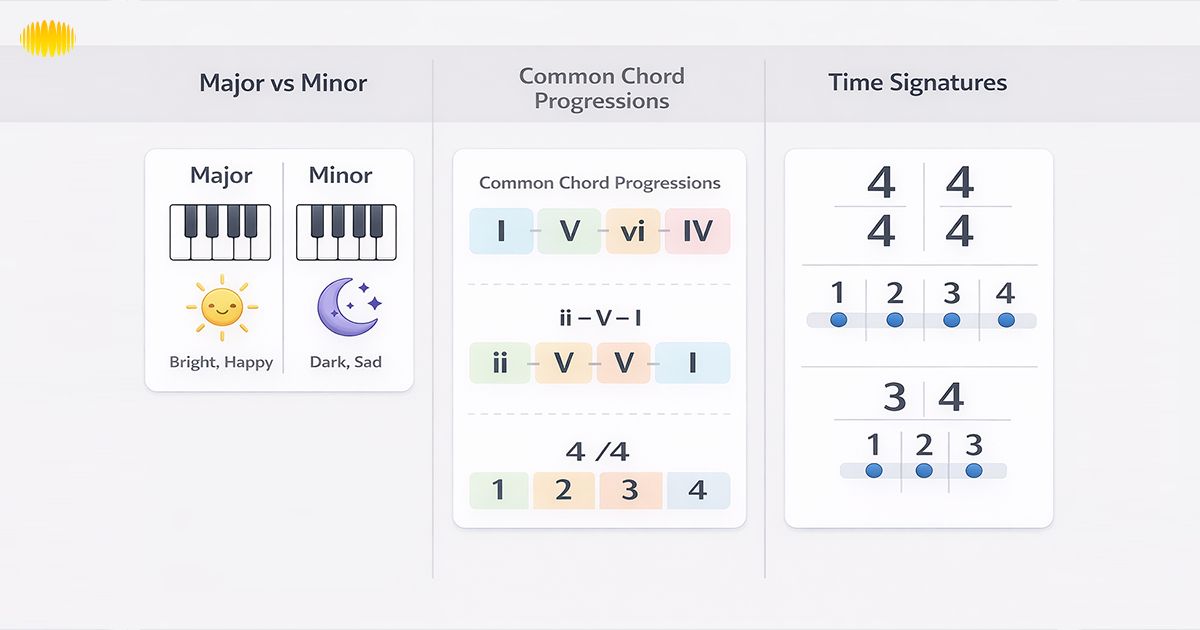
AI models respond more consistently when prompts reflect real musical structure. Defining key, tempo, chord movement, and time signature reduces randomness and improves harmonic continuity. Minor keys introduce tension.
Major keys create brightness and resolution. Clear structural instructions, such as 4/4 meter or defined bar lengths, guide the model toward cohesive composition instead of fragmented loops.
Major vs Minor
- Major keys = bright, resolved
- Minor keys = emotional, tense
If you want introspective lo-fi, minor works better.If you want motivational pop, the major often wins.
Modes
- Natural minor = cinematic tension
- Pentatonic = simple melodic hooks
- Dorian = jazzy brightness with minor feel
Common Chord Progressions
I–IV–V
Strong for pop and classic rock.
ii–V–I
Foundation of jazz harmony.
vi–IV–I–V
Modern pop anthem progression.
Specifying chord progressions improves harmonic coherence.
Example: “Use ii–V–I progression in D minor.”
Time Signatures
4/4 = Standard modern music
3/4 = Waltz feel
If you want a cinematic waltz: “3/4 orchestral waltz at 90 BPM.”
Structure Concepts
Clear structure improves professional feel:
- 8-bar intro
- 16-bar verse
- 8-bar hook
AI models respond well to bar-based instructions.
Recommended Read: Diss Song Generator
GENRE-SPECIFIC PROMPT FRAMEWORKS
Prompt sets are based on genres and give you a direction for your AI Music creation. You don’t offer nebulous characterizations but rather directives: mood, BPM range, key signature, instrumentation style and setup, arrangement style and process; production philosophy according to each genre.
It’s a method of making something steadier by removing randomness from the equation. When you pick a genre, the AI produces sound that at least one person might plausibly consider to be someone’s honest attempt at being stylistic and not just uncomposed-sounding or surprising.
Lo-Fi Hip-Hop
Melancholic lo-fi hip hop at 78 bpm in a-min, dry swing drum beat loop, gentle vinyl crackle SFX, ghostly Rhodes chords melody, and warm sub bassline inside. 16-bar easy sample flip composition that I enjoyed listening back to.
Mood: Nostalgic, mellow, introspective
BPM: 70–90
Key: A minor, D minor
Instrumentation: Dusty drums, vinyl crackle, Rhodes piano, subdued bass
Arrangement: Loopable 8–16 bars
Production: Warm saturation, tape hiss
Recommended Read: AI Song Lyrics Generator
Prompt Template
Melancholic lo-fi hip-hop at 78 bpm. Key: A minor. Dark dusty swing drum groove with smooth vinyl crackle and light white noise, Rhodes electric piano chords, warm sub bassline (processed analog), 16 bars seamless loop for easy track creation and songwriting - soft analog saturation is applied on the final mixing.
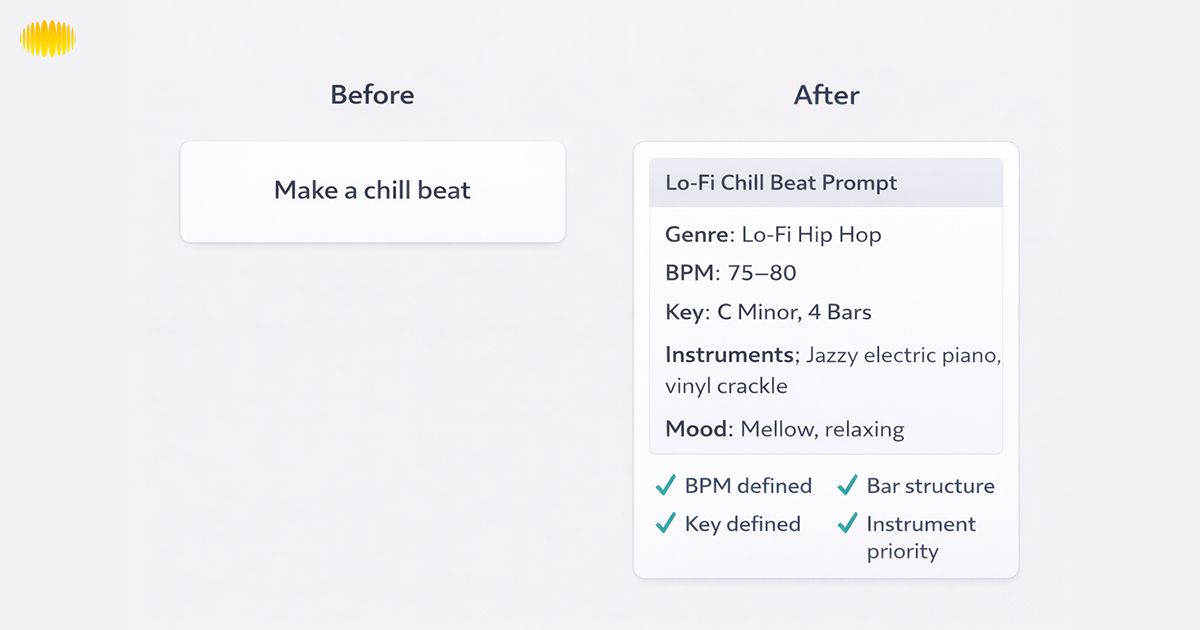
Before Prompt
“Make a chill lo-fi beat.”
Result: Generic drum loop, random piano.
After Prompt
Sad lo-fi hip-hop at 75 BPM key of D minor with warm dusty swing drums with vinyl crackle texture, Rhodes piano chords, light muted bassline, and seamless 16-bar looping format to keep the vibe going perfectly, featuring soft saturation from worn-out tape.
Result: Cohesive, genre-accurate loop.
Use Cases
- Study streams
- Vlog background
- Loop packs
- Streaming distribution
Monetization
Upload instrumental albums to streaming platforms. Create loop packs for producers. License for background music in creator marketplaces.
Jazz
Mood: Smooth, improvisational, loungeBPM:
- 90–140 swing
- 70–90 ballad
Key: F major, Bb major, D minorInstrumentation: Saxophone, upright bass, brushed drums, pianoHarmony: ii–V–I progressionProduction: Live room ambience
Prompt Template
Seamless Loop. Smooth jazz quartet in F major leitmotif at 126 beats per minute swing feel, walking upright bass line, brushed drum kit production, piano comping with ii–V–I 7th 9th chords, and an expressive tenor saxophone lead - discreet live club atmosphere.
Before Prompt
“Generate a jazz song.”
Result: Random brass loops.
After Prompt
Happy swing jazz in Bb at 130 BPM, walking upright bass line, brushed snare, piano with chord extensions on the seventh and ninth chords via ii–V–I movement; expressive horn theme. Small club reverb.
Result: Structured jazz feel.
Use Cases
- Podcast intros
- Premium brand content
- Lounge streaming playlists
Monetization
Create niche jazz instrumental EPs.License for hospitality brands.Build royalty-free jazz packs.
EDM / Electronic (House, Techno, Dubstep)
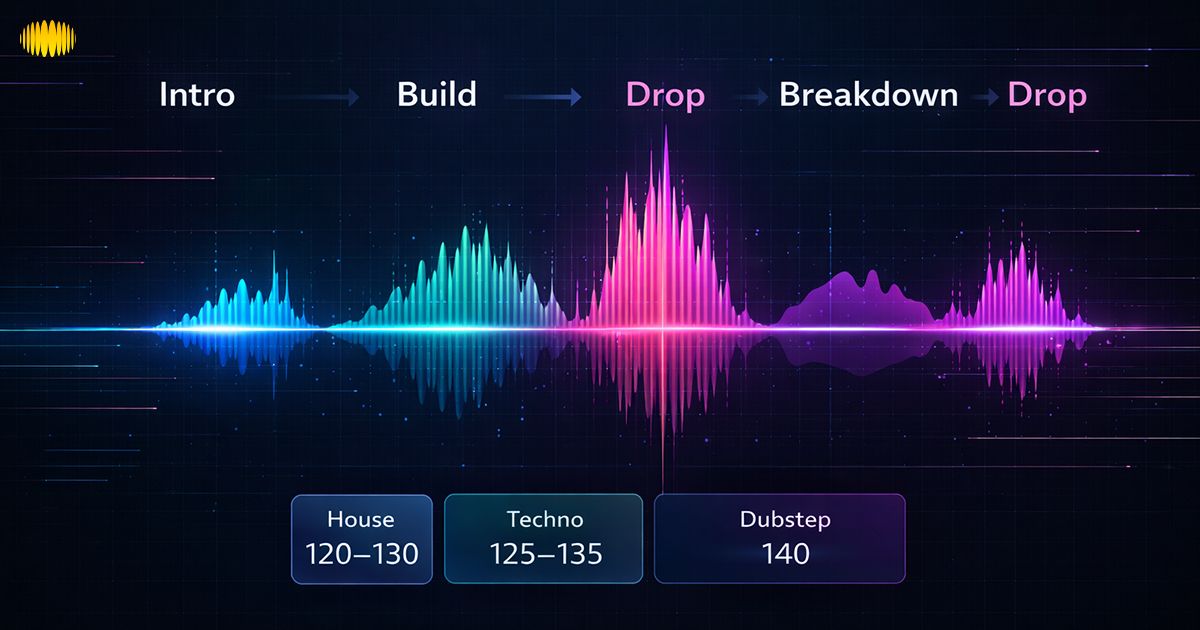
EDM requires structural precision. Without defining arrangement, drop timing, and rhythmic mechanics, AI models often produce repetitive loops instead of performance-ready tracks.
Subgenres & BPM Ranges
House
- BPM: 120–130
- Rhythm: Four-on-the-floor kick
- Structure: Intro → Build → Drop → Breakdown → Drop
- Sound: Piano stabs, bass groove, supersaw leads
Techno
- BPM: 125–135
- Rhythm: Driving kick with minimal melodic variation
- Structure: Progressive evolution rather than dramatic drops
- Sound: Repetitive synth motifs, subtle modulation
Dubstep
- BPM: 140
- Structure: Tension builds → Aggressive drop
- Sound: Wobble bass, syncopated drums
Recommended Read: Best AI Music Generators
Mini Prompt Templates (Standardized)
House Template
House 126 BPM G minor, four on the floor kick and groovy bassline with a supersaw drop at bar 33 supported by sidechain compression; intro:16 bars, riser build up:8 bars, breakdown: bar 49, second variation of the drop with additional percussion.
Techno Template
Minimal techno at 128 BPM in F minor, with a driving kick pattern; the interesting choice of hypnotic synth motif by 8 bars; subtle filter automation, and an increase in power as it progresses through 64 bars.
Dubstep template
16 bars present Dark Dubstep in 140 BPM, D minor. Atmospheric pads tension; snare rolls into hard swag wobble drop; syncopated drum pattern. And lastly, you have one or two bars for a regular tempo buildup.
Before Prompt
“Create a high-energy EDM festival track.”
Result: Repetitive synth loop without structural transitions.
After Prompt
Energy-filled house banger at 126 BPM in the key of G minor, four on the floor kick drum pattern, 16 bar intro, 8 bar riser build up, supersaw drop at bar 33 with sidechain compression pumping every beat, breakdown at 48 bars, and second drop switch.
What changed in the prompt
- BPM defined numerically
- The bar number defines drop placement
- Specific rhythmic pattern (four-on-the-floor)
- Section timing is clearly mapped
What improved in output
- Structured drop placement
- Predictable build tension
- Clear club-ready arrangement
- Reduced randomness
Classical
Classical prompts require meter, structure, and dynamic control. Without defined phrasing and form, AI often produces repetitive melodic fragments.
Framework
- BPM: 60–110
- Keys: C major (bright), A minor (dramatic)
- Time Signature: 4/4 or 3/4
- Structure: ABA or sonata cues
- Dynamics: Crescendo, legato, staccato
Prompt Template
Romantic classical A minor 72 bpm, 3/4 waltz time piano and strings ensemble, ABA form, legato phrases with a slow build to a halfway climax, decrescendo finish.
Before Prompt
“Create a classical piano piece.”
Result: Static repeating piano phrase.
After Prompt
Dramatic classical piece in C minor, 68 BPM, 4/4 time, 8 bar piano intro, strings enter at bar 9, ABA form, legato phrasing, dynamic crescendo to bar 40– soft diminuendo into resolution.
What changed in the prompt
- Time signature defined
- Entry timing defined
- Section form specified
- Dynamic movement included
What improved in output
- Cinematic flow
- Clear harmonic progression
- Dynamic arc
- Structured development
Pop / Trap
Contemporary trap beat at 145 beats per minute in the key of E minor, deep 808 glide bass, high speed triplet hi-hat rolls, punchy snare on beat three, 16-bar verse with an 8-bar hook section, sparse melodic synth lead sound design element, stark digitally mastered sound ready for digital platforms.
Framework
- BPM: 100–160
- Key: Minor for trap, major for pop
- Instrumentation: 808 bass, hi-hat rolls, snare/clap, synth lead
- Structure: Verse → Hook → Verse → Hook → Bridge
Prompt Template
Modern trap production at 145 BPM in E minor, huge 808 glide bass, high speed triplet hi-hat rolls, punchy snare on beat three, 16-bar verse into 8-bar hook, minimal melodic synth lead line, current chart-friendly trap mix with clean digital mastering.
Before Prompt
“Create a trap instrumental.”
Result: Basic 808 loop without hook identity.
After Prompt
Dark trap beat at 140 bpm in Dm, low, hard bassline 808 glides, syncopated hi hats roll with triplet variation, hard snare on the 3 count makes it knock, 16 bar verse to an 8 bar hook section driven by a synth lead melody with catchy chanting or repeating phrase style lyrics, mastered mix for quality streaming.
Result: Clear structure and hook placement.
What changed in the prompt
- BPM defined numerically (145 BPM instead of “fast trap”)
- Hook length defined clearly (8 bars)
- 808 glide behavior specified
- Hi-hat rhythmic pattern clarified
What improved in output
- Strong hook identity
- Clear verse–hook transition
- More controlled low-end response
- Streaming-ready commercial structure
Use Cases
- Short-form video trends
- Streaming singles
- Beat licensing marketplaces
Monetization
- Distribute singles
- License beats
- Sell exclusive rights
- Offer royalty-free loop packs
Cinematic / Orchestral
Cinematic orchestral music relies on dynamic movement and layered instrumentation to create emotional progression.
Framework
- BPM: 60–120
- Key: Minor for tension
- Structure: Rise → Climax → Resolution
- Instrumentation: Strings, brass, percussion, choir
Prompt Template
Epic cinematic orchestral D minor 95 bpm slow string build layered brass hits deep percussion gradual ascension to dramatic climax at 60 seconds resolved ending choir swell.
Before Prompt
“Make epic orchestral music.”
Result: Static orchestral loop.
After Prompt
Dark cinematic orchestral score in A minor at 90 BPM, low string ostinato intro, brass swells in at 16 bars, timpani build, slow crescendo to dramatic climax at one minute, resolved string ending with controlled decrescendo.
Result: Clear dynamic arc.
What changed in the prompt
- Tonal center defined (A minor)
- Entry timing defined (strings at 16 bars)
- Dynamic arc defined
- Climax timing specified
What improved in output
- Emotional build progression
- Clear orchestral layering
- Structured cinematic arc
- Reduced loop repetition
Use Cases
- Trailers
- Storytelling videos
- Game scoring
Monetization
- Create 30-second trailer cutdowns
- Produce 60-second sync-ready edits
- Offer 90-second dramatic builds for film placements
- Deliver stems pack (strings, brass, percussion separated)
- Export alternate mixes (instrumental, no choir, percussion-heavy)
Recommended Read: Meaningful Funeral Songs For The Older Generation
Why Specific Prompts Change the Output
AI models weight early tokens more heavily, meaning the first 5–10 words strongly influence genre direction. Adding numerical constraints reduces entropy in generation. Conflicting descriptors such as “dark, happy, energetic, slow” degrade output coherence and increase randomness.
1. Genre-First Positioning
Always place the genre at the beginning.
Correct:
“House track at 124 BPM…”
Avoid:
“Energetic track with house elements…”
2. Numeric precision
Use actual BPM values instead of “fast” or “slow.” Define sections by bar count:
- 8-bar intro
- Drop at bar 33
- 16-bar loop
Instrument priority order
Mention dominant instruments first. Example: “Four-on-the-floor kick, bass groove, supersaw lead…”
Arrangement mapping
Define transitions explicitly.
- Build → Drop
- Verse → Hook
- Rise → Climax → Resolution
The more structured your constraints, the lower the generative entropy. Precision directly improves genre accuracy and structural coherence.
Recommended Read: How To Choose The Right AI Music Generator
Prompt Templates Library
Template: [Mood] + [Primary Genre] + [Subgenre/Era] + [BPM] + [Key/Mode] + [Core Instruments] + [Structure with bar counts] + [Production Style] + [Deliverable length or loop format]
Example: Dark cinematic orchestral score at 90 BPM in A minor, low string ostinato, brass swells, 8-bar intro, climax at 60 seconds, gradual decrescendo ending, 2-minute deliverable.
| Genre | Mood | BPM | Key | Instrumentation | Structure |
|---|---|---|---|---|---|
| Lo-Fi | Nostalgic | 70–90 | A minor | Dusty drums, Rhodes | 16-bar loop |
| Jazz | Smooth | 120 swing | Bb major | Sax, upright bass | ii–V–I progression |
| House | Energetic | 120–130 | F minor | Kick, bass, supersaw | Build → Drop |
| Classical | Emotional | 60–110 | A minor | Piano, strings | ABA |
| Trap | Dark | 140–150 | D minor | 808, hi-hats | Verse → Hook |
| Cinematic | Epic | 80–100 | A minor | Strings, brass | Rise → Climax |
← Swipe horizontally to view full table →
From Prompt to Platform Monetization & Distribution
To maximize long-term revenue, organize releases into thematic collections rather than isolated tracks. Multiple versions, such as instrumental, looped edits, and extended mixes, increase licensing flexibility. Consistent metadata and catalog branding improve discoverability across streaming and sync platforms.
1. Streaming Royalties
Distributed through platforms such as DistroKid or Loudly. Ensure:
- Accurate genre tagging
- Clear instrumental designation
- ISRC code registration
- Consistent artist metadata
Streaming royalties are calculated per stream and vary by platform. Volume and catalog depth matter more than single-track virality.
2. YouTube & Short-Form Monetization
- Register tracks with Content ID
- Upload instrumental and loop versions
- Use 30–60 second edits optimized for Shorts
Short-form loops increase replay value and algorithm exposure.
3. Sync Licensing
Prepare:
- Instrumental versions
- Stems (drums, melody, bass)
- 30, 60, and 90-second edits
Submit to sync marketplaces targeting film, advertising, and gaming.
4. Royalty-Free Licensing
Bundle genre-specific packs:
- Lo-fi study collections
- Cinematic trailer packs
- EDM workout compilations
Structured prompt frameworks allow scalable catalog creation.
Ethical & Legal Considerations
Avoid using the names of living artists or recognizable styles to influence output. Instead, describe musical characteristics directly. Review your platform’s commercial rights policy to confirm ownership and redistribution permissions before publishing.
Maintain documentation:
- Exact prompt used
- Model version
- Generation date
This improves transparency for distributors and licensing partners. Always ensure metadata does not misrepresent authorship. Platform compliance protects monetization eligibility.
Recommended Read: AI Birthday Song Generator
Conclusion
Professionals treat AI prompts like production blueprints, not creative suggestions. When you define mood, genre, instrumentation, BPM, key signature, structure, and production style, you control randomness. Build reusable templates by genre. Store structured frameworks, track which combinations produce consistent results.
Monetization comes from systemization, not experimentation alone. Release catalogs. License variations. Register metadata properly. Refine prompts like production blueprints. Iterate with intention. Explore tools like Sonygram and build your own prompt engineering checklist to streamline your workflow.
Frequently Asked Questions (FAQ’s)
1. Can I specify a key in AI music prompts?
Yes. Specifying a key stabilizes harmonic direction and significantly reduces randomness. When you define a key such as A minor or G major, the model aligns chord movement and melodic phrasing around a fixed tonal center.
2. What BPM works best for lo-fi?
Lo-fi hip-hop typically performs best between 70–90 BPM. This tempo range supports relaxed drum swing, minimal melodic phrasing, and loop-based structure. Slower BPM values allow space between hits, reinforcing the calm, nostalgic aesthetic common in study and background playlists.
3. How detailed should instrumentation be?
The more specific you are, the more accurate the output becomes. Replace general terms like “piano” with precise descriptors such as “Rhodes electric piano,” “brushed acoustic drums,” or “sub bass with glide.
4. Can I monetize AI-generated music?
Provided your AI platform grants commercial rights. Before distribution, confirm ownership terms, licensing scope, and redistribution permissions. Proper metadata registration, ISRC assignment, and genre tagging are essential for collecting streaming royalties and sync revenue.
5. How do I avoid copyright issues?
Avoid referencing living artists or requesting stylistic imitation. Instead, describe musical characteristics directly. Maintain documentation of your exact prompt, model version, and generation date. This improves transparency and protects your eligibility for distribution and licensing platforms.
6. Does specifying chord progression improve output?
Including chord progressions such as ii–V–I or vi–IV–I–V increases harmonic coherence. When you define progression structure, the model generates more musically logical transitions instead of random chord shifts, resulting in stronger genre authenticity and compositional flow.